'%3E%3Cpath fill='%233A5C8D' d='M18.08 2H1.93C.87 2 0 2.85 0 3.9v15.5l.22.02c9.75 0 17.7-7.8 17.86-17.42Z' /%3E%3Cpath fill='%233A5C8D' d='M26.33 2H24.2C24.05 14.97 13.35 25.48.22 25.48L0 25.47v2.61C0 29.14.87 30 1.93 30h24.4c1.06 0 1.94-.86 1.94-1.92V3.91c0-1.05-.88-1.9-1.94-1.9Z' /%3E%3Cpath fill='%23262C49' d='M39.27 31.8c-.74-.2-1.28-.74-1.28-1.48 0-.88.67-1.55 1.56-1.55.23 0 .37.03.64.03 1.7 0 2.92-.63 2.92-3.02V10.52c0-1.04.74-1.81 1.8-1.81 1.01 0 1.76.77 1.76 1.81v15.73c0 3.9-2.34 5.75-5.83 5.75a5.1 5.1 0 0 1-1.57-.2Zm8.01-28.87a2.34 2.34 0 0 1-2.37 2.28 2.32 2.32 0 0 1-2.38-2.28 2.31 2.31 0 0 1 2.38-2.3 2.35 2.35 0 0 1 2.37 2.3Zm9.26 14.31a2.62 2.62 0 0 1-2.66 2.57 2.6 2.6 0 0 1-2.67-2.57 2.6 2.6 0 0 1 2.67-2.56 2.63 2.63 0 0 1 2.66 2.56Zm4.56 6.89V1.81C61.1.77 61.84 0 62.9 0c1.01 0 1.76.77 1.76 1.81v22.32c0 1.05-.75 1.82-1.76 1.82-1.02 0-1.8-.77-1.8-1.82Zm21.93-8.53v8.57a1.7 1.7 0 0 1-1.76 1.78 1.73 1.73 0 0 1-1.76-1.78v-.2a6.88 6.88 0 0 1-5.13 1.98c-3.46 0-5.8-1.92-5.8-4.77 0-2.9 2.37-4.7 6.14-4.7h4.72v-1.09c0-2.25-1.3-3.52-3.57-3.52-1.39 0-2.64.5-3.69 1.54-.44.37-.82.54-1.23.54-.84 0-1.55-.7-1.55-1.48 0-.5.23-.97.7-1.44a8.39 8.39 0 0 1 6.08-2.32c4.31 0 6.85 2.55 6.85 6.89Zm-3.6 3.73v-.3h-4.27c-1.93 0-2.95.7-2.95 2.01 0 1.35 1.15 2.19 2.92 2.19 2.4 0 4.3-1.72 4.3-3.9Zm25.67-1.99c0 4.98-3.46 8.61-8.14 8.61-2.38 0-4.38-.9-5.64-2.42v.6c0 1.08-.74 1.82-1.72 1.82-1.06 0-1.8-.77-1.8-1.82V1.81C87.8.77 88.58 0 89.6 0c1.01 0 1.76.74 1.76 1.81v9.32a7.07 7.07 0 0 1 5.56-2.42c4.72 0 8.18 3.66 8.18 8.63Zm-3.66-.03c0-3.09-2.14-5.38-5.1-5.38-3.01 0-5.02 2.19-5.02 5.41 0 3.2 2.04 5.38 5.03 5.38 2.95 0 5.09-2.28 5.09-5.4Zm6.66 6.09c-.34-.3-.51-.67-.51-1.15 0-.84.71-1.54 1.6-1.54.37 0 .74.13 1.11.47a5.66 5.66 0 0 0 3.9 1.71c1.46 0 2.68-.6 2.68-1.85 0-1.07-.98-1.5-2.34-2.05l-1.7-.7c-2.67-1.11-4.34-2.32-4.34-4.81 0-3.06 2.58-4.77 5.88-4.77 2.13 0 4 .77 5.29 2.01.37.34.54.74.54 1.18a1.5 1.5 0 0 1-1.5 1.51c-.37 0-.67-.16-1.11-.5a5.47 5.47 0 0 0-3.3-1.14c-1.32 0-2.27.5-2.27 1.58 0 .9.68 1.34 2.2 1.95l1.6.63c3.02 1.25 4.55 2.56 4.55 4.98 0 3.32-2.85 5.04-6.17 5.04a8.25 8.25 0 0 1-6.11-2.56Z' /%3E%3C/g%3E%3Cdefs%3E%3CclipPath id='a'%3E%3Cpath fill='%23fff' d='M0 0h120.38v32H0z' /%3E%3C/clipPath%3E%3C/defs%3E%3C/svg%3E)
Agent Frameworks Under the Microscope: Hype or Real Architectural Advantage?
Simple code suggestions in the IDE are no longer enough. As autonomous agent systems move into mainstream engineering workflows, teams are shifting their focus from generating code to designing scalable, predictable architectures. Agent frameworks can deliver a real competitive advantage — but only when they give you control over data flow, cloud costs, and model behavior.
Key Takeaways
- An agent framework is not an AI model, but an orchestration layer that controls how the model executes tasks.
- The cost and stability of an agentic system depend primarily on workflow architecture — unlimited loops, shared context, and poorly designed dependencies can quickly increase infrastructure spending.
- In enterprise environments, architectural advantage comes from state control, context management, action plan verification, and clearly defined boundaries for AI behavior.
Today, organizations can choose from a wide range of agent frameworks and orchestration approaches — including LangGraph, Semantic Kernel, CrewAI, and Microsoft Agent Framework. In this article, we focus on comparing the classic Group Chat pattern with the Magentic approach because they illustrate the difference between simple agent collaboration within a shared message thread and more advanced orchestration, where the system continuously plans, verifies, and adjusts the agents’ course of action.
What Is an Agent Framework and Why Does Architecture Matter?
An agent framework is a backend orchestration layer that automates tool routing, permissions, and retry mechanism. In the classic chat completion model, the chat API itself does not manage persistent process state on the application side. Increasingly, however, LLM providers are moving beyond this simple model toward APIs that support more agentic patterns of behavior, closer to a ReAct loop (Reasoning and Acting). It is important to distinguish between two layers.
- Workflow engine — manages task flow, state transitions, and business rules in a graph (e.g., LangGraph).
- Agent runtime — executes tasks through the LLM and handles tool interactions (e.g., CrewAI).
This separation decouples business logic from the AI provider. The orchestrator enforces deterministic state transitions and validation, turning the model into a replaceable execution module. For architects, this is essential — controlled workflow design reduces the cost of model migration and limits dependency on a single AI provider. A key part of this control is how the system manages context and token usage.
What Is an Agent Framework and Why Does Architecture Matter?
Modern agent architectures often use token-efficiency techniques such as context caching and prompt compression. These mechanisms buffer static instructions and reduce noise, so the system doesn’t resend the full context with every request. The result: lower inference costs and more stable model behavior at scale.
Why a Poorly Designed Agent Can Cost More Than a Developer
When model nondeterminism meets weak workflow design, cloud costs can spike fast. The biggest cost drivers include:
- inference on full prompt histories,
- retry loops that generate excessive cross‑agent traffic,
- cascading latency and concurrency bottlenecks.
Consider a simple scenario: no retry limit + shared conversation history. When an agent fails to parse a response, it keeps modifying the query instead of raising an exception — sending a heavier payload each time. In production systems, dozens of unnecessary iterations per request can turn into thousands of extra API calls per day.
Under a conservative assumption of 30 unnecessary iterations per request across 1,000 daily requests, the system generates 30,000 redundant API calls every day. While the exact cost depends on the chosen model and prompt length, this level of overhead quickly scales a project out of the “experimentation” budget and quickly becomes a noticeable line item in the cloud budget.
Group Chat and Magentic: Different Levels of System Control
In the classic Group Chat pattern, agents work within a shared message thread. In complex tasks, this can lead to context noise, lower predictability, and rising API costs.
The Magentic approach is not a simple opposite of Group Chat, but a more advanced variant of it. The key role is played by the orchestrator, which plans the agents’ work, tracks progress, verifies subsequent steps, and adjusts the action plan based on current information.
| Architectural Parameter | Group Chat | Magentic |
| Context management | Shared, ever‑growing history | Controlled information flow through the orchestratorisolated task and progress logs |
| Predictability | Low; prone to retry loops | Higher thanks to planning, verification, and plan correction |
| Scalability | Limited by noise | Higher with well-designed orchestration |
| Cloud economics (ROI) | High token overhead | Greater control over execution flow and costs |
In practice, Group Chat can create information noise when agents work in a shared thread and rely on an ever-growing conversation history. Magentic does not completely reverse this model. Instead, it adds a stronger orchestration layer: planning, progress tracking, result verification, and action plan updates. This makes the system easier to control and debug, although it does not automatically mean full agent isolation.
This also does not mean that the Magentic approach is always simpler or cheaper to implement. It requires more orchestration code, more careful workflow design, and safeguards to ensure that agents do not lose information needed in subsequent steps.
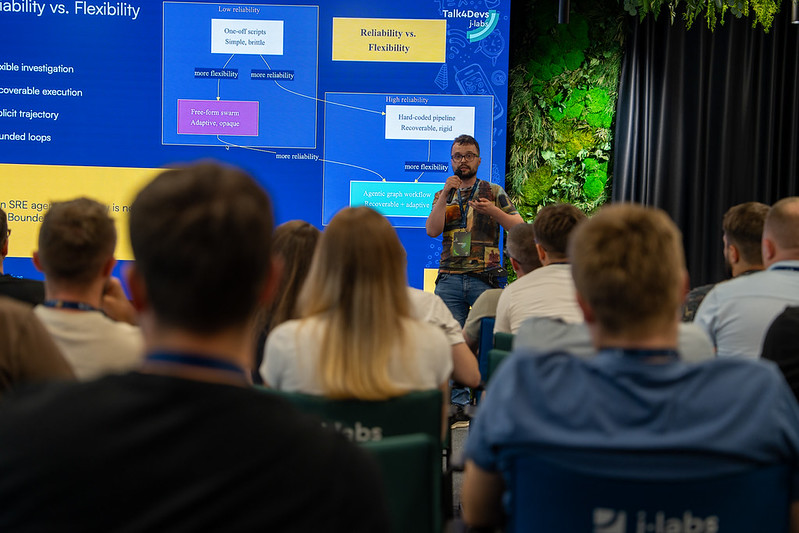
Speaking at Talk4Devs, Jakub Gajski, Jakub Gajski, AI Technical Lead at j‑labs, emphasized:
“In enterprise environments, stability and cost-efficiency come primarily from the constraints imposed by the orchestration layer, state control, and continuous verification of the agents’ action plan”.
When Does an Agent Framework Make Sense?
It is worth implementing when:
- The business process involves multiple, branching decision steps.
- There is a need to dynamically integrate and orchestrate several different backend tools.
- Strict state control and data validation between workflow stages are critical.
It is NOT worth implementing when:
- A properly deployed, straightforward RAG pipeline is fully sufficient to solve the problem.
- The entire process layout can be handled by classic, deterministic business logic.
- The expected output can be delivered via a single model call with a well-crafted prompt.
FAQ
Why do AI agents generate such high cloud costs?
Most frequently, this is caused by a shared, continuously bloating context window, a lack of limits in retry loops, and redundant cross-agent communication. Every unconstrained iteration drastically inflates token consumption and drives up unnecessary API fees.
What is more critical: the model or the orchestration?
In production-ready enterprise systems orchestration takes precedence. LLM models change rapidly and can be easily swapped out, but it is the rigid workflow, state control, and code-level validation that ultimately determine the stability and cost predictability of the entire solution.
Is an agent framework necessary for every AI project?
No. If a task is linear, one-off, or relies on basic information retrieval (RAG), introducing a complex agent framework will only add unnecessary architectural overhead and increase technical debt.
Conclusion
Agent architecture makes sense when it solves a real problem related to process complexity, tool integration, or state control. If these requirements are not present, a simpler workflow, RAG pipeline, or deterministic business logic may be cheaper, more predictable, and easier to maintain.
Build AI systems that scale without accumulating technical debt. At j‑labs, we help organizations design, build, and optimize scalable Data & AI solutions with predictable ROI. Let’s talk.
Agent Frameworks and Code Quality: Reducing the Risks of Nondeterminism and Vibe Coding
How to Build an IT Team That Deliver from First Sprint? A Proven j‑labs Framework
Meet the geek-tastic people, and allow us to amaze you with what it's like to work with j‑labs!
Contact us